By Eoghan Fitzgerald
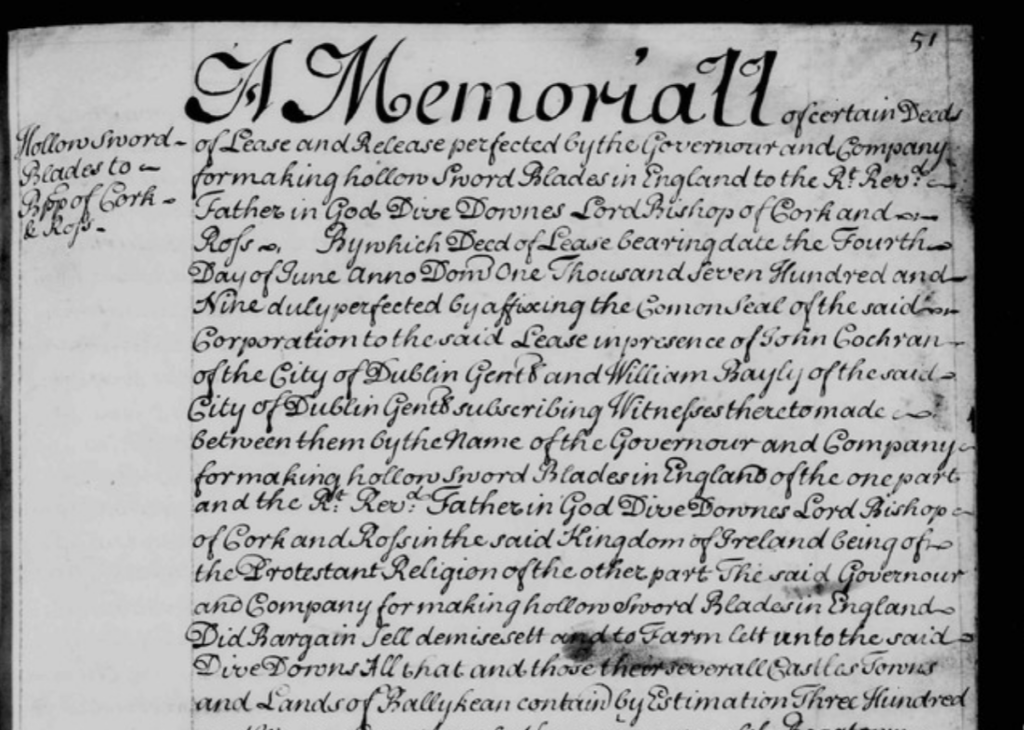
ROD PR/TB/1/4/713: Hollow Sword Blades to Bishop of Cork and Ross
(image: virtualtreasury.ie)
The Registry of Deeds (ROD) provide a valuable avenue for the study of individual, familial and corporate property holdings in Ireland in the eighteenth and nineteenth centuries. By looking at a particular family, it is possible to trace the acquisition and conveyance of land across time (e.g. through purchase, lease and/or sale). Using Memorial Books from the ROD, it is also possible to trace a particular plot of land as it was conveyed from one holder to another, which can give insight into how broader economic, political and legal contexts influenced conveyance practices both within and outside of the family unit. The value of the ROD as a source for exploring the strategies and practices that underpinned familial property ownership is demonstrated by the case of Dive Downes, Bishop of Cork and Ross, and his family, and particularly by the leasing of land in Philipstown (now Daingean, Co. Offaly) by Downes in 1709.
The land in question was leased to Downes by the Hollow Sword Blade Company of England for £119 per annum, with the option to buy outright for £1,700.[1] Prior to the War of the Two Kings in Ireland (1689-91), the land in Philipstown had been owned by the John Trant. The Trant family were staunch Jacobites, with John’s father, Sir Patrick Trant, being a member of James II’s parliament in Dublin in 1689. Following the Jacobite defeat in the war, the Trant lands were confiscated and granted by William III to Henri de Massue, 2nd Marquis de Ruvigny and earl of Galway, one of the military commanders responsible for the Williamite victory.[2] However, the English Parliament grew dissatisfied with the large grants made by the king to personal favourites and military generals, and this led to the passage of the Act of Resumption in 1700, which rendered many of those grants null and void. The Philipstown lands were thus returned to the crown and subsequently acquired by the Hollow Sword Blade Company – a joint stock company that was originally founded for the manufacture of hollow-ground rapiers but which was purchased in 1700 by a syndicate of businessmen, who used its corporate identity to operate as a bank.[3] The Hollow Sword Blade Company entered the Irish land market as speculators following legislation passed in 1702 and 1703, which was aimed at incentivising and expediting the purchase of land returned to the crown under the Act of Resumption. The company would purchase over 250,000 acres of forfeited land, becoming one of the largest landowners in Ireland. Their participation in Irish land speculation would be short-lived, however, as financial and legal difficulties marred the promise of profit and caused them to liquidate their remaining Irish land assets in 1709.[4] In total 11,288 acres of land confiscated from the Trants in King’s County (Offaly) were purchased by the Hollow Sword Blade Company; this meant that the 2,141 acres leased by Downes represented just part of the forfeited Trant estate.[5]
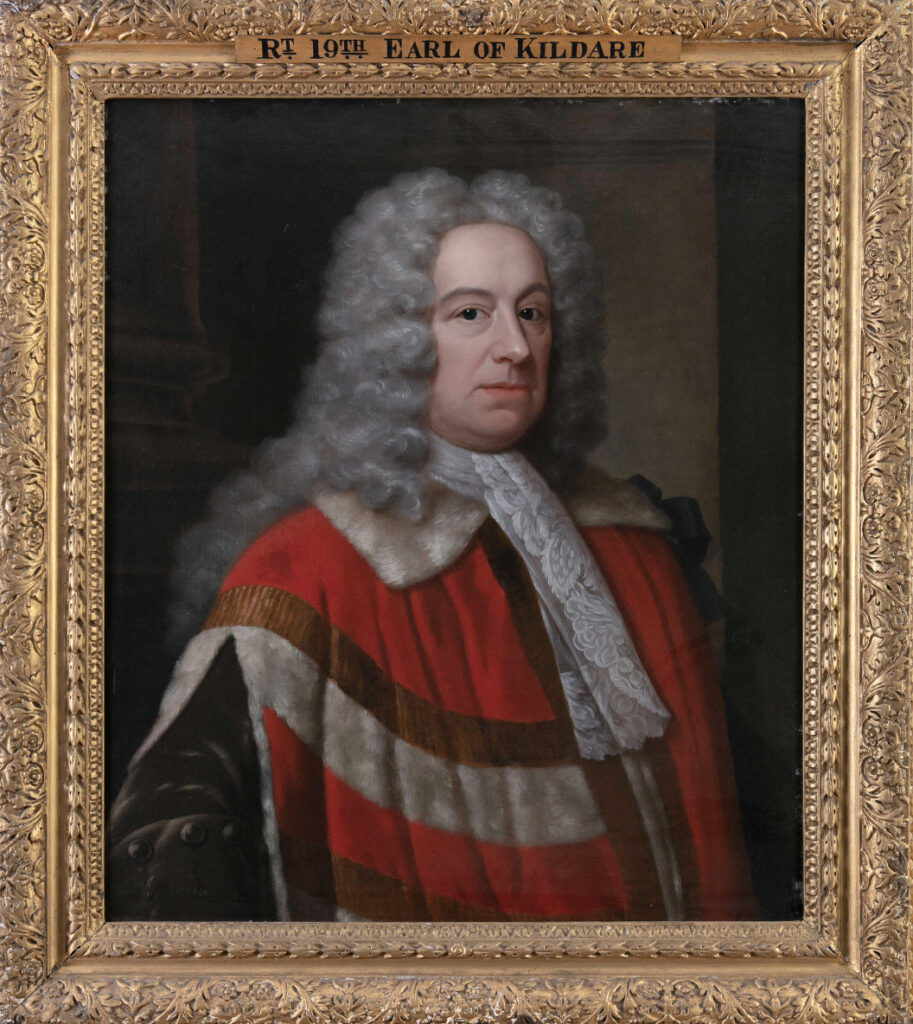
Robert Fitzgerald, 19th earl of Kildare.
By Frederick Graves, after the original (image: adams.ie)
Dive Downes died shortly after leasing the land and and in 1710 the leased land was purchased outright from the Hollow Sword Blade Company by Robert Fitzgerald, 19th Earl of Kildare, the brother of Downes’ widow, Catherine.[6] While Lord Kildare never officially transferred ownership of Philipstown to Catherine or her children, Anne and Robert Downes, it is evident that they retained a financial interest in the lands, as they received rental income from leases even after Kildare’s acquisition of the land.[7] The Philipstown lands appear to have been intended to provide for Anne and Robert Downes’ future, as evidenced by both the rental income derived from leases on the land and a conveyance made between Robert and Anne prior to Anne’s marriage, in which Anne sold her share of the Philipstown lands to her brother for £2,000.[8] This ensured that Anne had a generous portion, which made her an attractive prospect on the marriage market, and it also meant that familial control over the land was not jeopardised by coverture, the common law practice whereby a married woman’s real property (land) came under her husband’s control.[9]
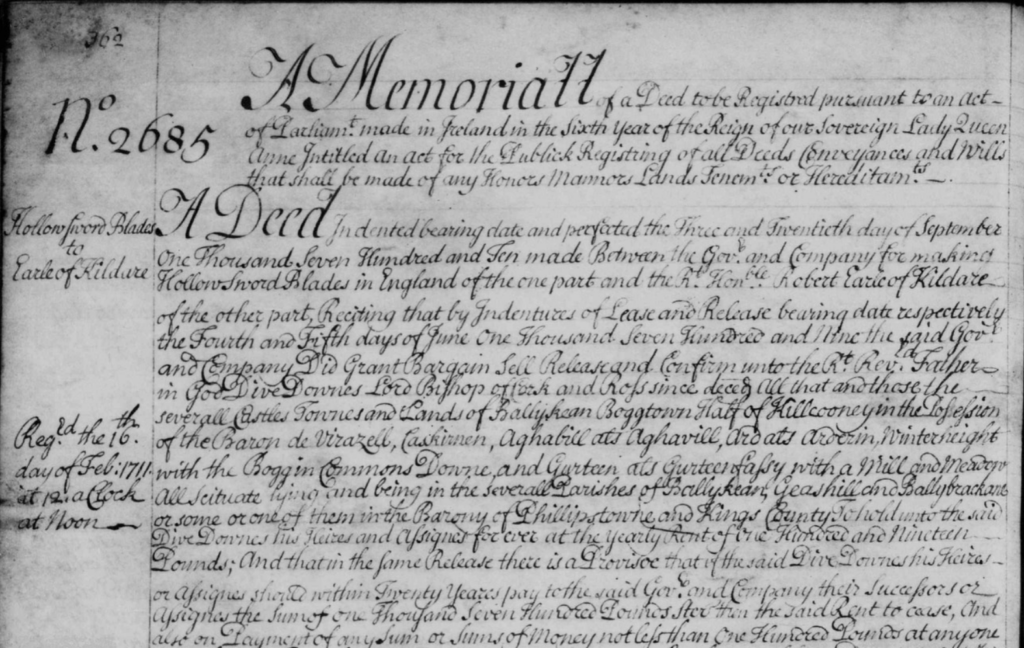
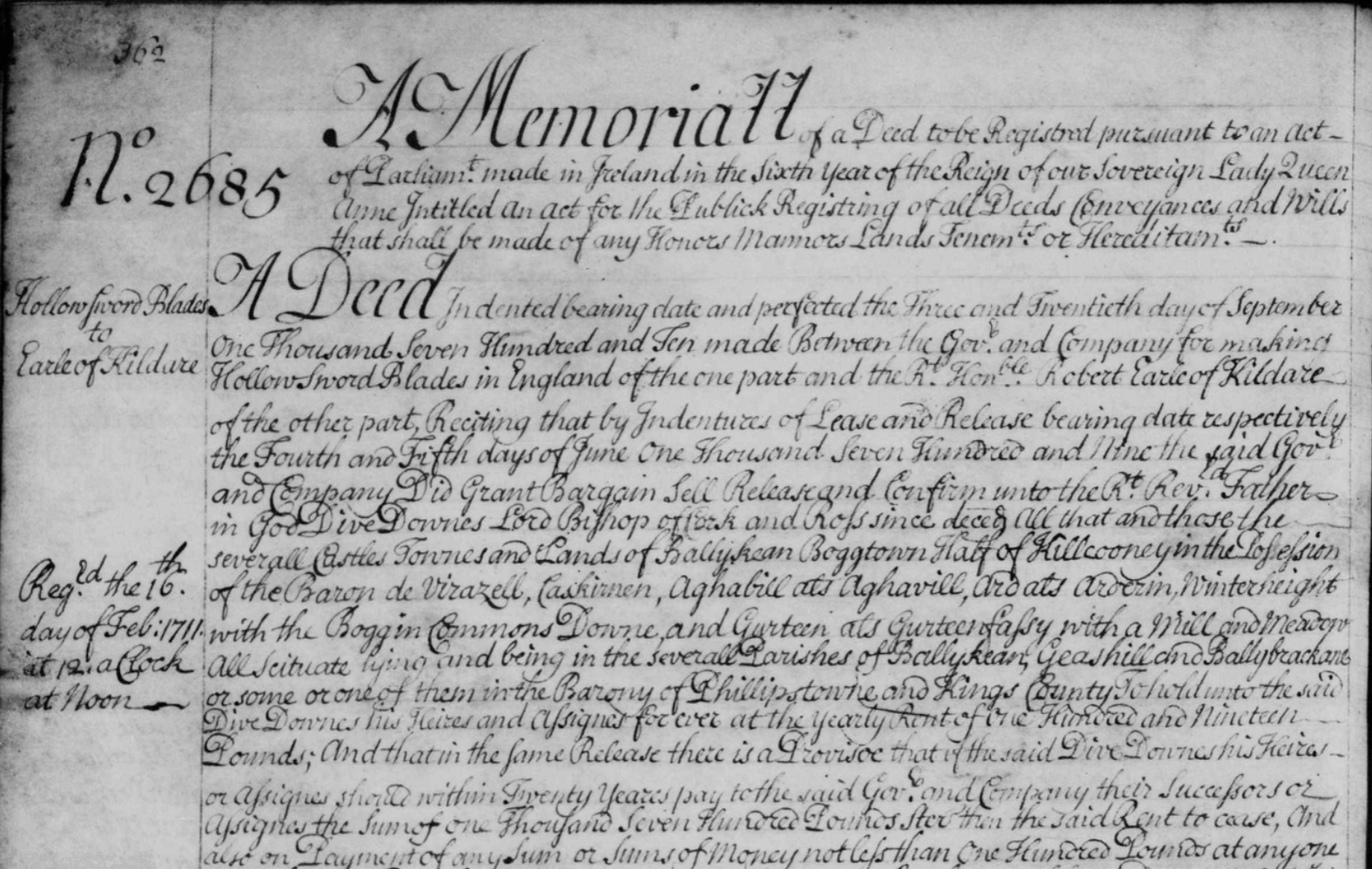
ROD PR/TB/1/7/2685 – Hollow Sword Blades to earl of Kildare
(image: virtualtreasury.ie)
As the Downes’ case demonstrates, the ROD is a hugely valuable source for the study of property ownership (including its acquisition and conveyance) in eighteenth-century Ireland. The ROD memorials shine a light on the complexity of ownership in this period, particularly when situated within wider political, economic and legal contexts, and shaped by familial dynamics and obligations. The leasing of the Philipstown lands by Dive Downes and its subsequent purchase by Kildare following Downes’ death provides a useful case study. The instability caused by the Williamite confiscation and the subsequent Act of Resumption represented an opportunity for Dive Downes, a Church of Ireland clergyman on the rise. Downes’ was a clear beneficiary of the land settlement, leasing land from the Hollow Sword Blade Company, which had purchased the Trant family’s confiscated estate. The ability to enter the property market at a moment of plasticity allowed Downes to secure his family, but his death meant this could only be achieved through his wider kin network. Downes’ brother-in-law, Kildare, was clearly subject to familial dynamics and obligations; this meant that, while he purchased the lands of Phillipstown, he also allowed his newly widowed sister and her children to retain their financial interests in it. In addition, the conveyance of this interest from Anne to Robert Downes before her marriage guaranteed her portion (enhancing her marriageability), while evading the diminishing effects of coverture. In short, this was a strategy to ensure that the family estate remained intact and solely under their control. While complimentary sources such as marriage records or the list of forfeited estates purchased by the Hollow Sword Blade Company are useful in contextualising property transactions, the original ROD Memorials are indispensable to our understanding of the Downes’ case – and countless others – as the terms of the transactions laid out therein provide an avenue for understanding the subtle nuances beyond simple ownership of the land in question.
[1] Hollow Sword Blade Co. to Bishop of Cork, (1709), Dublin, Registry of Deeds [hereafter RoD], Memorial Books, 4/50/713.
[2] Erasmus D Borrowes, ‘The French Settlers in Ireland. No. 5. The Huguenot Colony at Portarlington, in the Queen’s County.’ In Ulster Journal of Archaeology, 3(1855) pp. 62-65.
[3] Downes to Dolier (1714), RoD, Memorial Books, 18/171/8781.
[4] Stuart Bell, ‘‘A masterpiece of knavery’? The activities of the Sword Blade Company in London’s early financial markets.’ in Business History, 54:4(2012), pp. 628-634.
[5] A list of the several estates in the King’s County, belonging to the Governor and Company for Making Hollow-Sword-Blades in England, with the quantity of acres, as by the survey of the late trustees for sale of the forfeitures (Dublin, 1709), pp. 1-2.
[6] Hollow Sword Blade Co. to Earl of Kildare, (1710), RoD, Memorial Books, 7/362/2685.
[7] Downes to Dolier, (1714), RoD, Memorial Books, 18/171/8781; Downes to Newcombe, (1731), RoD, Memorial Books, 76/83/52932.
[8] Downes to Downes, (1731), RoD, Memorial Books, 70/52/47325.
[9] Marriage of Thomas Burgh & Anne Downes, Ireland Diocesan And Prerogative Marriage Licence Bonds Indexes 1623-1866, p. 171.
Bibliography:
Primary Sources:
A list of the several estates in the King’s County, belonging to the Governor and Company for Making Hollow-Sword-Blades in England, with the quantity of acres, as by the survey of the late trustees for sale of the forfeitures, (Dublin, 1709), pp. 1–2.
Downes to Dolier, (1714), Dublin, Registry of Deeds [hereafter RoD], Memorial Books, 18/171/8781.
Downes to Dolier, (1714), RoD, Memorial Books, 18/171/8781; Downes to Newcombe, (1731), RoD, Memorial Books, 76/83/52932.
Downes to Downes, (1731), RoD, Memorial Books, 70/52/47325.
Hollow Sword Blade Co. to Bishop of Cork, (1709), RoD, Memorial Books, 4/50/713.
Hollow Sword Blade Co. to Earl of Kildare, (1710), RoD, Memorial Books, 7/362/2685.
Marriage of Thomas Burgh & Anne Downes, Ireland Diocesan and Prerogative Marriage Licence Bonds Indexes 1623–1866, p. 171.
Secondary Sources:
Bell, Stuart, ‘‘A masterpiece of knavery’? The activities of the Sword Blade Company in London’s early financial markets’, Business History, 54:4 (2012), pp. 628–634.
Borrowes, Erasmus D. ‘The French Settlers in Ireland. No. 5. The Huguenot Colony at Portarlington, in the Queen’s County’, Ulster Journal of Archaeology, 3 (1855), pp. 62–65.
Leave a Reply