When we look at early modern Irish historical sources, it is no exaggeration to say that the lives and experiences of the Irish peasantry and the ‘middling sorts’ are largely confined to the margins; they appear fleetingly in surviving state papers or court records, and are often incidental players in the letters, household account books, estate ledgers and legal papers of the elite. The non-elite in Irish society typically appear in estate/family papers as a source of income (i.e. as tenants on an estate) or expenditure (i.e. as servants or suppliers of goods and other services). Occasionally, however, a source will provide more substantial detail on the lives, experiences and/or characters of ‘ordinary’ Irish people who lived centuries ago.
This is demonstrated by the records of a testamentary case that came before the Court of Delegates in 1693, between Anne O’Dempsey (née Bermingham), Viscountess Clanmalier, and Terence Quin. It was not untypical for a will to be contested in the early modern period, resulting in rounds of litigation across several years. Until the nineteenth century, probate was the responsibility of the ecclesiastical courts, with Irish testamentary cases being dealt with by the Prerogative Court of Armagh or the Prerogative Court of Canterbury.
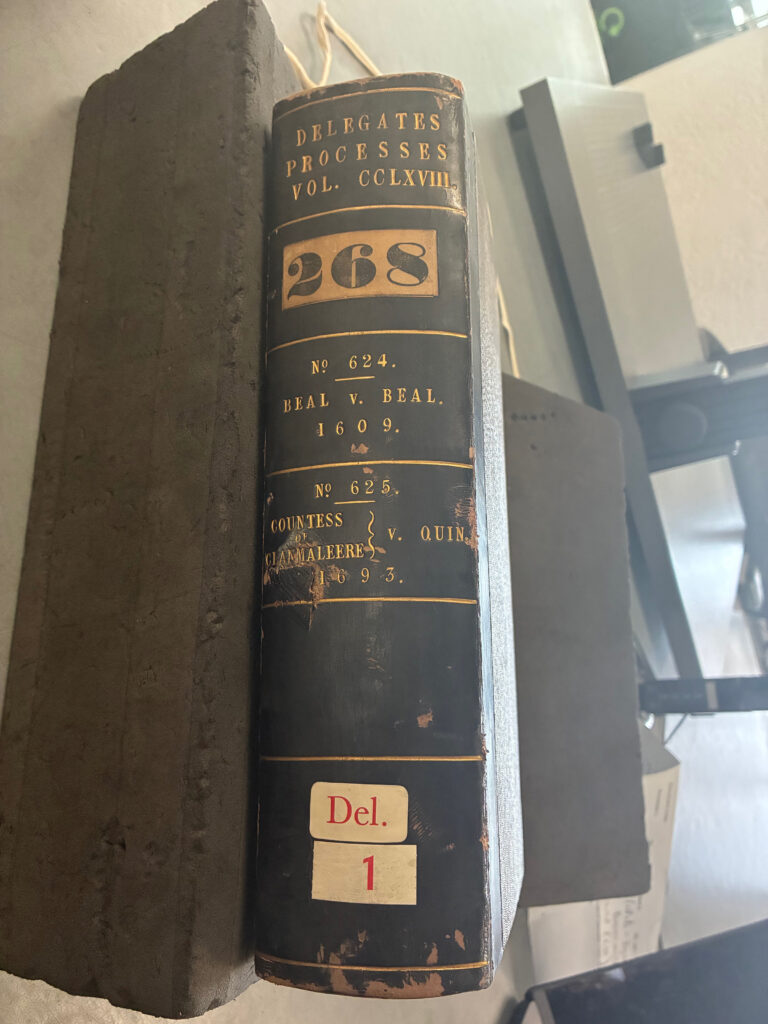
The final court of appeal for testamentary cases, however, was the Court of Delegates – so called because the judges were delegated for each case. Appeals in Irish cases were thus heard by the Court of Delegates. The resultant records, which are now held in the National Archives at Kew (reference: DEL 1-11), contain authenticated copies of proceedings from lower courts (DEL 1). Among other things, proceedings comprise copies of allegations, answers and witness depositions. This is true of ‘Countess of Clanmalier v Quin’, (DEL 1/268/625), which originated in the Prerogative Court of Armagh in 1692, before winding its way to the Court of Delegates in 1693.[1]
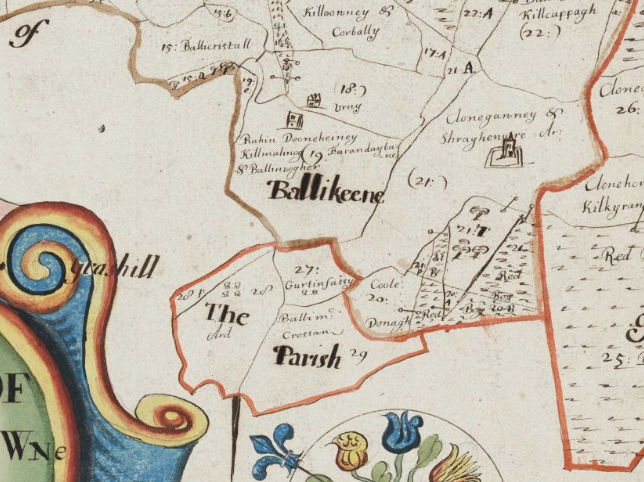
The lawsuit arose after the death, in 1690, of Maximilian O’Dempsey, 3rd Viscount Clanmalier, between his widow, Anne (née Bermingham), Viscountess Clanmalier, and his nephew, Terence Quin. Quin swore to the Prerogative Court of Armagh that an ailing Lord Clanmalier determined to make a will on 29 November 1690, that he had ‘call’d for pen & inke’ but there was none available at his home in Ballykean in County Offaly, and that his request to have his will witnessed by two gentleman was similarly frustrated, with the activities of Raparees in the county making travel dangerous.
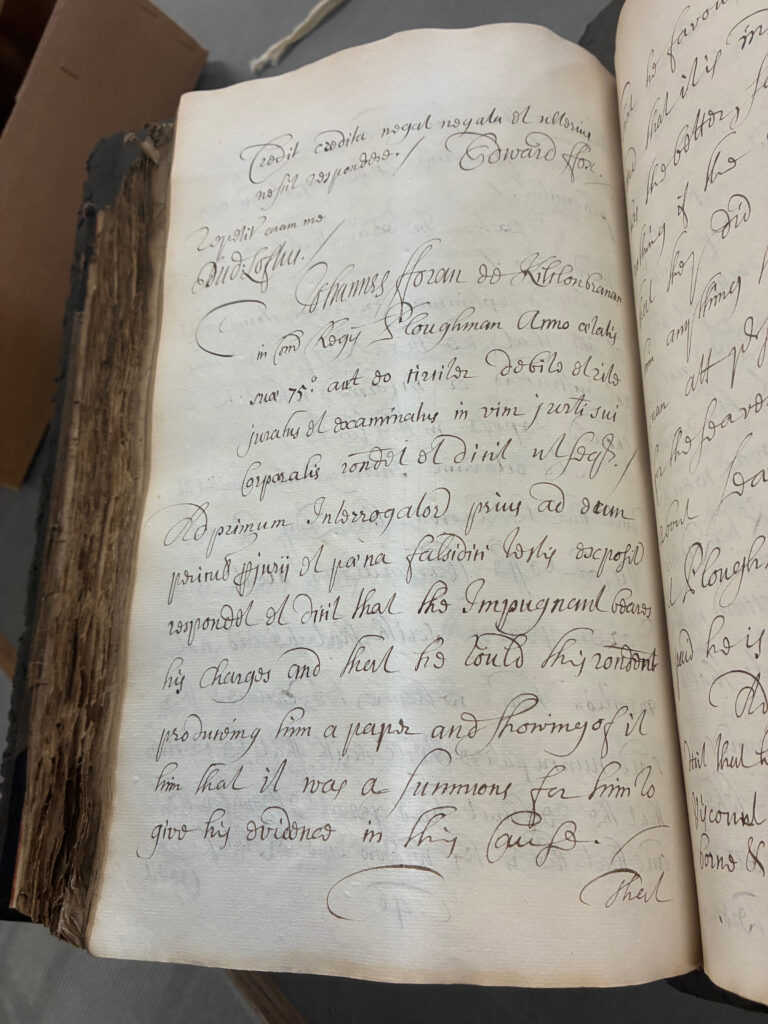
Lord Clanmalier was instead compelled to declare his will orally (known as a nuncupative will) in front of ‘severall good and credible witnesses’ from the locality. This included Fr Edward Fox, a Catholic priest who lived with Lord Clanmalier and served as his chaplain for five or six years; John Foran from ‘Kilclonbranene’ (Clonbrennan?); John Byrne of Mountmellick; and Elizabeth Heelan from Kilcooney. All of Quin’s witnesses were Irish speakers, which reflected the prevalence of the native language in rural Ireland and indicated Lord Clanmalier’s bilingualism. On the agreement of both parties, one John Dempsey was employed to ‘interprett indifferently’ between the witnesses and the English-speaking court.
The testimony of Quin and his witnesses diverged on certain points, but they agreed that Lord Clanmalier had made some or all of the following provisions: £500 to Colonel James Dempsey and his children; £90 as a legacy for his soul; £60 to his chaplain, Fr Fox; £5 to a Fr Molloy; £3 to Fr Dermot Malone; and 40 shillings to Fr Philip Reilly. (Indeed, Clanmalier’s award of legacies to four priests demonstrates the significance of the Catholic nobility in providing patronage to the church and its clergy in the late seventeenth century.) Significantly, the witnesses who appeared before the court also testified that Lord Clanmalier had left the rest of his estate or a sum of £500 to Quin, who was his sister’s son. Quin explained the omission of Lady Clanmalier from her husband’s will by pointing out that he had previously settled a lifetime interest in lands valued at £2,500 on her.
Lady Clanmalier’s counsel, Richard Bourke asserted that Quin had ‘misbehaved himselfe’ and had ‘not demean’d himselfe respectfully’ toward Lord Clanmalier. Bourke further argued that Lord Clanmalier’s nuncupative will (which was subsequently committed to paper) was fabricated or had been altered in Quin’s favour and he interrogated the witnesses who appeared on Quin’s behalf to determine the truth of the matter. As well as shining a light on their respective connections to Lord and Lady Clanmalier and Terence Quin, the witnesses’ testimonies reveal a significant amount about their personal circumstances. Speaking in Irish, John Foran testified that he was 75 years old and had resided at ‘Kilclonbranene’ for seven years, where he worked as a ploughman, adding that with his debts paid, he was not worth three pence. Foran knew Lord Clanmalier since the latter’s birth, and it was this long acquaintance that compelled him to visit the dying nobleman, who then spoke of his intentions for his estate in Foran’s presence.
Seventeen-year-old John Byrne dwelt in Lord Clanmalier’s house for three years before the nobleman’s death, where he was likely employed as a servant. Like Foran, he spoke in Irish and swore to the Prerogative Court that – along with Fr Fox, John Foran, Elizabeth Heelan, and a (since deceased) clerk named James Dempsey – he had heard Lord Clanmalier declare his intentions for his estate. Byrne also divulged details about his life after Clanmalier’s death, confirming that he had returned to live with his father in Mountmellick in County Laois, where he served as an apprentice glover.
Elizabeth Heelan testified in the Irish language, too, and informed the court that she was about 26 years old, that she lived in Kilcooney with her husband and brother and that she was ‘not worth twenty shillings in the world.’ Heelan was probably a servant – like Byrne, she resided in Clanmalier’s house at the time of his death. According to her testimony, she was part of a group with Fox, Foran, Byrne, Dempsey and another woman named Catherine Kelly, who heard Lord Clanmalier speak about his wishes for his estate ‘about eight or nine days’ before he died. However, Heelan confirmed that the viscount did not intend his comments to be taken for a will; she instead believed that he would make his will in the presence of Fr Fox, at a remove from his servants and neighbours.
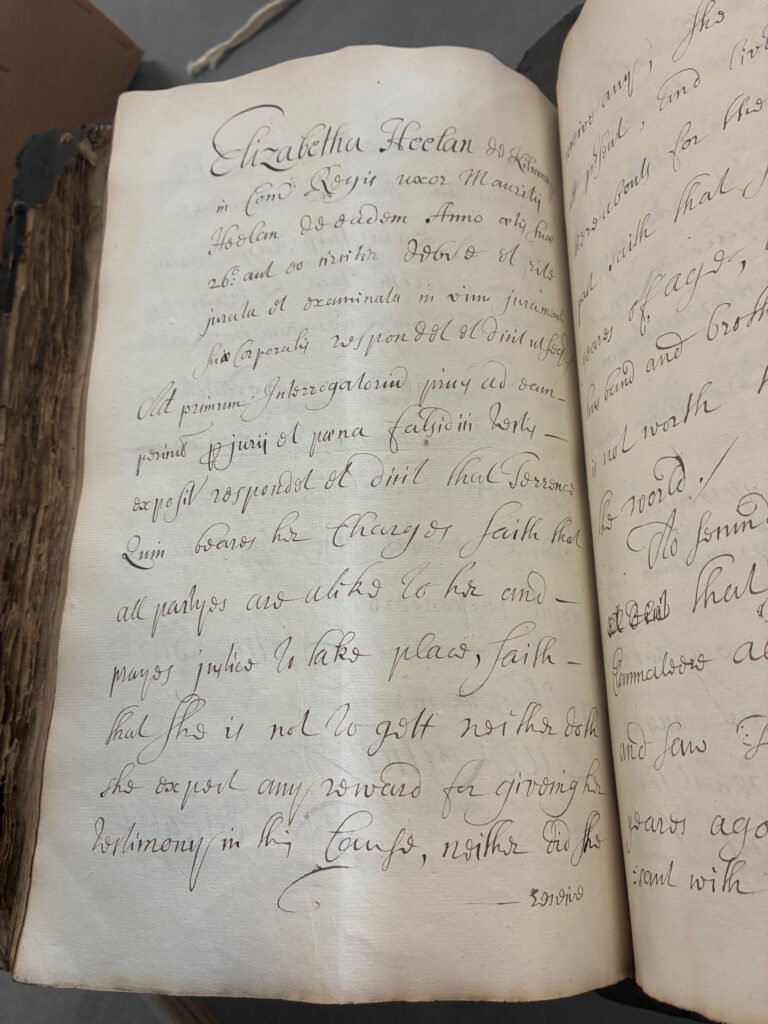
Among other things, the witnesses were asked whether they knew Lady Clanmalier and whether or not Lord Clanmalier had a ‘great esteem’ for her ‘during his life’; they were also asked if they expected to gain anything from Terence Quin for agreeing to appear on his behalf. All swore that they expected no remuneration for their appearance before the court, and Fox, Foran and Heelan each confirmed that they had known Lady Clanmalier for many years and that they knew her to be held in great esteem by her husband. John Byrne, however, diverged on this point; he suggested that there was an estrangement between the couple and stated that he ‘often heard his Lordship say that he wonder’d why her Ladyship stay’d away.’
‘I often heard his Lordship say that he wonder’d why her Ladyship stay’d away.’
Statement of John Byrne to the Prerogative Court of Armagh
(Countess of Clanmalier v Quin, 1692)
As a servant, John Byrne’s proximity to Lord Clanmalier allowed him intimate knowledge of the nobleman’s life. The formal framework of a court case, meanwhile, provided him with an opportunity to put that knowledge on the record and, ultimately, to put himself into the historical record. Of course, we cannot know how much of Byrne’s testimony was true, but his claim that the Clanmaliers lived separate lives is backed up by other evidence: in 1676, after making a bad investment, Lord Clanmalier agreed that his wife could have a separate settlement of the Kildare lands she had brought to their marriage, as the coheir (with her sister, Mary) of her brother, John Bermingham. Lady Clanmalier used part of her income to build a house near Oxmantown Green in Dublin and very rarely visited her husband after that point.[2]
It is possible that Byrne, alongside Foran and Heelan, received some inducement for testifying on behalf of Quin, who could offer them a financial reward for bending the truth. The economic disparity that existed between each of them and Quin and the Clanmaliers was patent. Fr Fox certainly had something significant to gain for presenting his version of Lord Clanmalier’s will. In some ways, however, the truth of their testimonies is less significant than their relatively substantial presence in the historical record. Theirs are not the voices that we typically find in early modern Irish sources; their testimonies were mediated both by an interpreter and the court clerk who transcribed their translated speech, but they nonetheless appear as individuals, with their names, ages, places of residence and occupations recorded for posterity.
We can interpret their testimonies in different ways, but we meet them as individuals, with full lives, and we cannot be indifferent to their presence in the record.
[1] Full reference: TNA, DEL 1/268/ 625, ff 1-178, Countess of Clanmalier v Quin (1693).
[2] See PRONI, Annesley Mss, vol. iii, ff 136-140.
Leave a Reply