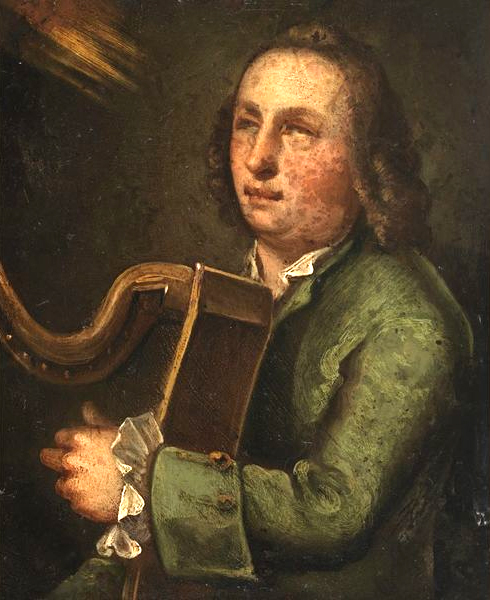
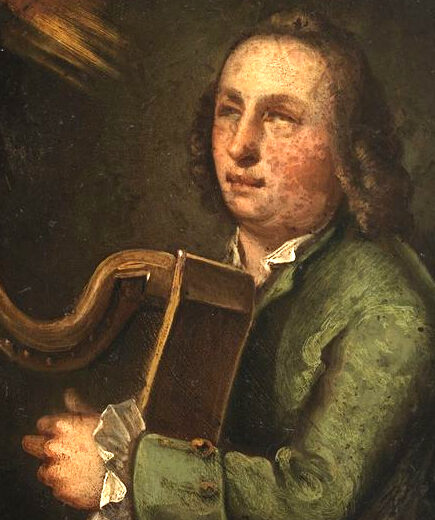
To those with an interest in the history of Irish music, the name Turlough Carolan – commonly known as ‘Carolan’ – will be familiar. The celebrated harper was born in Nobber, County Meath, to a family that lost their lands in the Cromwellian plantation. With little prospect of recovering their estates, they moved to Roscommon in the 1680s, where Carolan’s father was employed by the MacDermott Roe family.[1] After being blinded by smallpox at eighteen, Carolan was apprenticed to a harper. He was not considered to be a gifted performer, but his talent for composition took him all over Ireland, writing music for wealthy patrons, one of whom was Eleanor Plunkett.[2] Eleanor was born into an Old English Catholic family in the late seventeenth century; like the Carolans, the Plunketts lost lands in County Meath under Cromwell, but the family reestablished themselves around the barony of Kells after the Restoration of Charles II.[3]
‘Nelly an Chúil Craobhaigh’
The lyrics of the song that Carolan composed for Eleanor survive in two written versions: the better known of the two, titled ‘Neillí Pluincéad’, was published by Tomás Ó Máille in 1915.[4] There is also a nineteenth-century manuscript version of Carolan’s lyrics, titled ‘Nelly an Chúil Craobhaigh’ [‘Nelly of the flowing locks’], alongside a version of the harper’s tune, both of which were transcribed by James Cody and form part of the Edward Bunting Collection in QUB’s Special Collections.[5] That tune was published by Donal O’Sullivan in 1958,[6] although professional harper Simon Chadwick notes (in this blog post) that it does not easily accommodate the lyrics published by Ó Máille. Chadwick also suggests that the tune published by O’Sullivan as ‘Madam Keel’ is ‘Nelly an Chúil Craobhaigh’ by another name, with the confusion arising because Eleanor Plunkett’s married name was Cahill (Uí Chathail).[7]
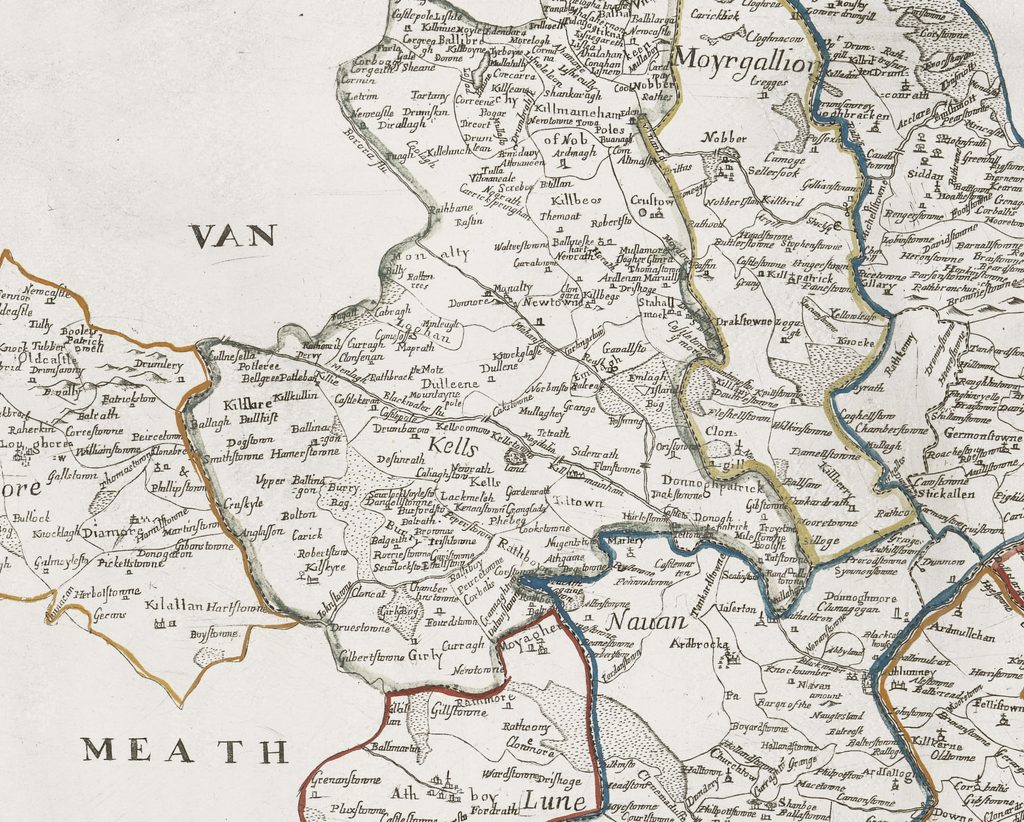
Interestingly, the lyrics to Ó Máille’s ‘Nelly Pluincéad’ and Cody’s ‘Nelly an Chúil Craobhaigh’ include a reference to the townland Ardmaghbreague, which is located to the north of the town of Kells, and which was part of a sixty-year lease agreed by Eleanor’s grandfather, Francis Plunkett, with Sir Thomas Taylor in 1680. Taylor was the son and namesake of a man who had come to Ireland with Sir William Petty to complete the Down Survey – one of a series of surveys carried out in the 1650s, to determine the allocation of confiscated Irish land to the soldiers and financers (known as ‘Adventurers’) involved in Cromwell’s military campaign in Ireland.[8] Thomas Taylor senior served as Chief Surveyor and Examiner on the Down Survey and afterwards acquired a significant estate around Kells; his descendants would eventually be raised to the Marquisate of Headfort and earldom of Bective.[9]
Ó Máille’s version of the lyrics include a more explicit reference to Eleanor Plunkett’s ancestral lands, in the lines: ‘Gur tú, a ghaoil, na bhfear éachtach ó Ardamacha bréige/ Fuair clú mhór ó Ghaodhalaibh le tréine do lámh/ Gidh nach maireann insa tír-sa ach thú do do ghaolta/ Ní isleóchainn mo ghlór d’éan neach dhá bhfuil beo’ [‘It is you, kin of the heroic men from Ardmacha bréige/ who won great renown through their might in battle/ Though you are the only one of your kin remaining in this land/ I would not lower my voice for any living soul’].[10] The reference to ‘Ardmacha bréige’ [Ardmaghbreague] suggests that Carolan wrote the piece for Eleanor in the 1720s, during which time she and her sister Mary were engaged in a lawsuit with Sir Thomas Taylor, concerning their grandfather’s lease of lands in 1680.
Changing circumstances
Francis Plunkett died in 1682, just two years after agreeing that lease with Taylor. He made a nuncupative (oral) will, leaving his real estate, leasehold property and moveable goods to his son, Thomas, excepting one third of his real and personal estate, which was left to his wife Catherine. Commonly referred to as ‘thirds’, this was the portion of an estate allowed to a man’s widow as her common law dower. Francis did not name an executor, so Catherine took out letters of administration and entered into possession of the estate on behalf of Thomas, who was still a minor at the time of his father’s death.[11]
Thomas Plunkett was killed by robbers or rapparees in 1691, while travelling along the road home from Dublin. He was survived by his widow, Bridget, and his daughters, four-year-old Mary and three-year-old Eleanor.[12] Bridget subsequently remarried to John Walker, and he submitted a claim to the trustees for the Irish forfeitures in 1700, as guardian to Eleanor and Mary. The sisters’ were named as co-heirs of their late father and their claim sought the postmortem return of their grandmother Catherine’s dower lands, which amounted to 166 acres in the Barony of Kells. These lands were comprised in the lease agreed by Francis Plunkett in 1680 and were mistakenly believed to be forfeit by the outlawry of Catherine’s second husband, Edward Dowdall, for his support of James II in the War of the Two Kings.[13]
Eleanor and Mary’s claim was allowed,[14] but they do not appear to have gained possession of the lands thereafter. They were orphaned on the death of their mother in 1704 and both subsequently married – Mary to William Donnellan and Eleanor to John Cahill. As married women, Eleanor and Mary were not permitted to initiate a legal action on their own behalf, so they were joined by their husbands in bringing a suit against Taylor in the Irish Court of Exchequer in 1720.[15]
The Lawsuit
Their bill of complaint stated that Edward Dowdall had travelled west of the Shannon after the Jacobite defeat at the Battle of the Boyne in 1690, leaving Catherine in possession of the Plunkett lands and a mansion house. As a woman alone, she was vulnerable to the vicissitudes of war and it appears that she suffered greatly at the hands of Sir Thomas Taylor, who was accused of reneging on the lease he agreed with Francis Plunkett, and of seizing the Plunkett-Dowdall property. Taylor, who was a captain of the local militia, allegedly ‘entered on the premises with an Armed Power, and seizing upon the said Catherine, took her forceably out of her said Dwelling-house, and sent her a Prisoner to his own Town of Kells.’ He was also accused of seizing Catherine’s goods and corn, valued at £360.[16]
Taylor’s response claimed that Catherine was actually removed from the property by others, to satisfy a Government order that the wives of rebels should be sent ‘beyond the Shannon.’ The rent thus went unpaid and the premises was plundered; a circumstance that prompted him, in May 1692, to enter the property and begin making improvements and repairs. Taylor asserted that he shortly afterwards agreed a new contract with Thomas Plunkett, who took part of the property for ‘a certain Term and Rent, and held and enjoyed the same … for some time, without setting up any Title under the Old Lease’; this was a patently false claim, as Thomas Plunkett had been dead since 1691.[17] In addition, Taylor argued that a 1697 penal law – An Act to prevent Protestants intermarrying with Papists – barred the Catholic Eleanor’s Protestant husband, John Cahill, from acting as an administrator on Catherine Dowdall’s estate.[18]
The court ruled in favour of Eleanor and Mary and their husbands in 1722, but Taylor appealed and subsequently invoked his privilege as an MP to frustrate the suit. In the end, they pursued an appeal to the highest court – the British House of Lords – but they were unsuccessful and so lost any right to the lands in the lease agreed by their grandfather in 1680.[19] It was almost certainly in this fraught period that Carolan composed his song for Eleanor Plunkett, celebrating her connection to the land of her ancestors. Its survival has immortalised that connection, weaving the Plunketts’ story into the very fabric of Irish culture. It has also bequeathed to us a poignant image of the woman behind Carolan’s planxty – ‘Nelly an chúil craobhaigh, a bhfuil do dhá shúil ar dhath an fhéir ghlais,’ or ‘Nelly of the flowing locks, whose eyes are the colour of green grass.’[20]
[1] Harry White, ‘Carolan, Turlough (Ó Cearbhalláin), Toirdhealbhac’, Dictionary of Irish Biography (DIB), https://doi.org/10.3318/dib.001492.v1, accessed 8 October 2026.
[2] White, ‘Carolan’, DIB.
[3] King’s Inns Library (KIL), PET.V.4 (House of Lords Appeals), ff 599-606.
[4] Tomás Ó Máille, Amhráin Chearbhalláin (The Poems of Carolan), together with other N. Connacht and S. Ulster Lyrics (London: Irish Texts Society, 1916) pp182-3.
[5] QUB Special Collections & Archives, Edward Bunting Collection, MS 4.6.81-2.
[6] Donal O’Sullivan, Carolan : the life times and music of an Irish harper (Lincolnshire, 1958), no. 150, p. 94
[7] Simon Chadwick, ‘Eleanor Plunkett’. See https://simonchadwick.net/2020/12/eleanor-plunkett.html, accessed 1 October 2026.
[8] Frank Prendergast, ‘The Down Survey of Ireland’, Survey Ireland (Winter, 1997), p. 48.
[9] Prendergast, ‘Down Survey’, p. 48; NLI, Headfort Papers (Collection List No. 3), p. 3.
[10] Ó Máille, Amhráin Chearbhalláin, p. 182.
[11] KIL, PET.V.4 (House of Lords Appeals), ff 599-606.
[12] KIL, PET.V.4 (House of Lords Appeals), ff 599-606.
[13] NLI MS 3012, A list of the claims as they are entred with the trustees at Chichester House on College-Green, Dublin, on or before the Tenth of August, 1700 (Dublin, 1701), claim no. 1657.
[14] NLI MS 3012, claim no. 1657.
[15] KIL, PET.V.4 (House of Lords Appeals), f. 599-602.
[16] KIL, PET.V.4 (House of Lords Appeals), ff 599-601.
[17] KIL, PET.V.4 (House of Lords Appeals), ff 600.
[18] 9 Will. III, c. 3 (1697), An act to prevent Protestants inter-marrying with Papists; KIL, PET.V.4 (House of Lords Appeals), f. 600.
[19] KIL, PET.V.4 (House of Lords Appeals), ff 599-606.
[20] Ó Máille, Amhráin Chearbhalláin, p. 182.
Leave a Reply